More Than a Scholarship

Updated: Sep 1
On Reese Angel Cortez's first day as a Mano Amiga scholar, her mother left her with words she would carry for years.
“Make them proud. They believe in you as much as your papa and I do.”
For a young student, those words could have easily sounded like pressure. Instead, they became something else. They became a reminder that people she may never have known personally had chosen to believe in what she could become.
Reese eventually raised her general average from 85 to 96, became President of Mano Amiga's Scholars Club, and graduated with plans to continue her studies at Asia Pacific College. But when she reflected on her time as a scholar, she did not speak only about grades, awards, or financial assistance.
She spoke about belief.
To Reese, receiving a scholarship meant realizing that someone had looked at a young person's future and decided it was worth investing in.
That idea sits at the heart of Mano Amiga Philippines.
When Someone Believes in You
Mano Amiga began in the Philippines in 2008 as a small kindergarten program inspired by an education model first developed in Mexico. What began with the goal of making quality education more accessible has since grown into a full K-10 school and a wider community development organization.
Its scholarship model is based on a family's capacity to pay. During School Year 2024-2025, 260 students received either full or partial scholarships. Over the years, Mano Amiga says it has provided more than 2,000 scholarships to students from underserved communities.
Numbers like these show scale, but they do not always show what an opportunity feels like to the person receiving it.
For a family, a scholarship can mean one less door closing because of circumstances beyond their control.
For a student, it can mean walking into a classroom knowing that somebody has chosen to make room for their potential.
For Reese, that knowledge became motivation.
She wrote that knowing other people believed in her, sometimes even more than she believed in herself, pushed her to become more active academically and beyond the classroom.
There is something powerful about that.
Sometimes we assume people first need to prove themselves before they deserve an opportunity. Mano Amiga's story offers another way of looking at it. Sometimes the opportunity itself helps a person discover what they are capable of proving.
An Education That Goes Beyond Grades
Mano Amiga's work does not end when a student receives tuition support.
The organization describes its approach as one that forms the heart, mind, and soul. Alongside academics, students are exposed to leadership development, spiritual formation, Social-Emotional Learning, Project-Based Learning, clubs, community service, and opportunities to discover interests they may not have known they had.
In the classroom, this can look very different from simply memorizing information for an exam.
Kindergarten students have worked on reducing single-use plastics through a Zero Waste project. Grade 8 students have transformed discarded plastic bottles into hydroponic systems for growing vegetables. Students are encouraged not only to learn about problems, but to ask what they can do about them.
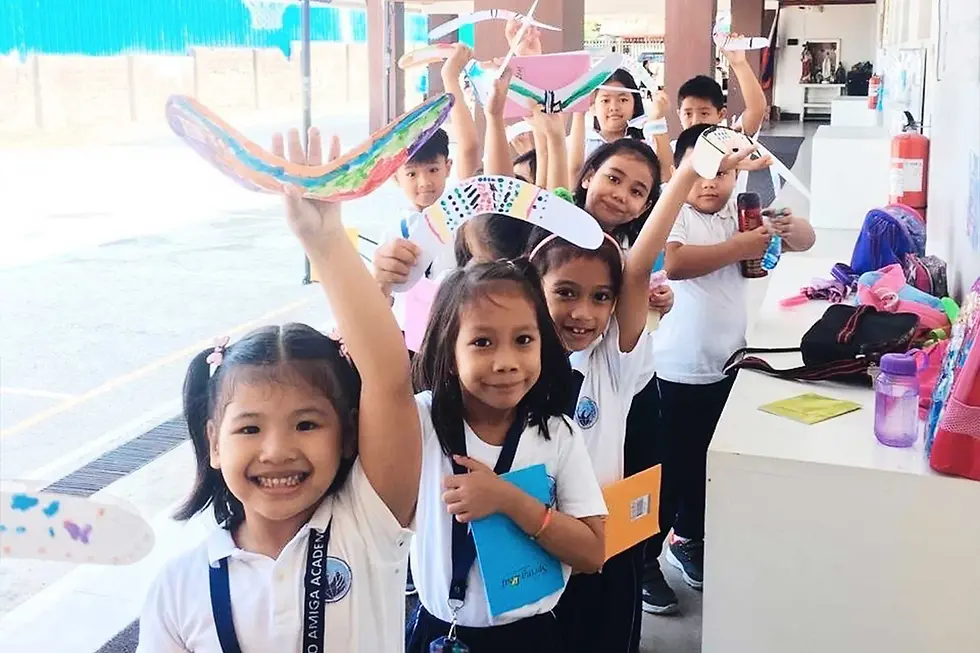
Education can give someone information.
But good education can also give someone confidence, curiosity, responsibility, and the belief that they have something to contribute.
The impact can be seen in students like Denise Solas, who entered Mano Amiga describing herself as shy and later graduated as the recipient of the school's highest honor. Looking back, she credited the opportunities she received with helping her grow and become more comfortable with who she was.
The goal, then, is not simply to help students reach graduation.
It is to help them leave understanding themselves differently from when they arrived.
The Helping Hand Reaches Further
What makes Mano Amiga's story especially meaningful is that the helping hand does not stop with the students inside the school.
The campus also serves as a community development center. Programs support parents and families through livelihood training, health and nutrition initiatives, parenting education, employment opportunities, and values formation. Mano Amiga also brings its education programs beyond its own campus through teacher training, literacy initiatives, STEM activities, and partnerships with underserved communities across the Philippines.
In 2025, more than 300 daycare workers participated in training on play-based learning. According to Mano Amiga, those educators could indirectly reach more than 14,000 young children.
Its STEM Link Up program has also connected students from Luzon, Visayas, and Mindanao with learning opportunities, workshops, peers, and STEM professionals.
At Nayon ng Kabataan in Mandaluyong City, Mano Amiga worked with children and young people who had experienced serious interruptions in their education. The annual report tells the story of one 16-year-old who entered the program struggling even to hold a pencil and recognize letters. With patient and consistent support, he gradually began developing basic reading and writing skills.
More Than a Scholarship
It is easy to think of a scholarship as money used to pay for school.
Technically, that is part of what it is.
But perhaps its real value cannot be found entirely on a receipt.
A scholarship can tell a child that their circumstances do not have to decide the limits of their future.
It can tell a parent that they are not carrying their hopes for their child alone.
It can tell a student, before they have accomplished everything they dream of accomplishing, that somebody already believes they are worth taking a chance on.
And sometimes, being believed in changes the way we begin to believe in ourselves.
Reese entered Mano Amiga as the recipient of someone else's generosity. She leaves wanting to become someone capable of giving that generosity forward.
That is when a scholarship becomes more than financial assistance.
It becomes confidence.
It becomes responsibility.
It becomes possibility.
And if the person who once received the helping hand eventually reaches back and offers it to someone else, then the impact of one opportunity may continue long after the scholarship itself has ended.


Comments